Sunday, March 30, 2008

Suburban Garden Expansion Part Three!

I came home to Pennsylvania this weekend to resume work on the garden. Spring is such a wonderful time to be alive! Many trees were budding (including both of my apple trees), and some were even flowering. On Saturday morning, birds are chirping everywhere, a falcon circled the turquoise sky. Our neighbor's dog, Biscuits, was lounging around, and my backyard was awash with the verdant colors of new growth.


Before even starting my work, I noticed strange tufts of green grass growing all around the back of our property and extending a bit into our neighbor’s yard. There were dozens of such plants. Upon closer examination, I realized that these little plants were the descendants of the 4 heirloom green onions that I grew last year. The green onions are cut and come again annual vegetables whose seeds are propagated by the wind. Apparently, the 4 original onion plants had cross-pollinated each other. Their children must have colonized the marginal lands adjacent to the two properties.

And the land is surely marginal, stuck between my garden and my neighbor's flower beds, it's rocky as hell and laced with pine needles. The only plants growing there are some weeds, lichen, and of course my onions!!! This fortunate colonization will provide our family with several times the amount of edible green onions as compared to last year, and without any additional effort on our part. What we are seeing is in effect, permaculture in action. Our plant has created a niche for itself in a previously barren habitat.


After examining the green onions, I went straight to work. Seven new V-shaped troughs were created with the trusty shovel and pick-ax. Three of them were along my neighbor’s fence to the east, another four were dug along the land bordering our neighbor to the south. These troughs were about a foot long, six inches wide, and ten inches deep. The bottom of each trough was lined with rich compost and buffered with three inches of organic garden soil. The four troughs along the southern edge of the backyard had to be fortified with extra garden soil, since the natural soil base there is so poor and rocky to begin with. Each trough is then given a single asparagus crown buried under another 3 inches of garden soil and then watered thoroughly. In time(hopefully) the asparagus will become a hedge like border that produces food and acts as a windbreak.

The asparagus is a perennial plant that once established, will produce nutritious green spears for decades. While the reproductive strategies of plants are varied and interesting in general, the strategy taken by the asparagus is highly unconventional in my opinion. Basically, a parent Asparagus’ root system is composed of crowns of individual root shoots. Now depending on environmental conditions or just plain chance, some of these crowns will bud off or get broken off from the main root structure. Each crown has the potential of becoming an independent Asparagus plant. Yet unlike other budding root plants, each crown isn’t a clone of the parent, it’s actually a bundle of genetically distinct child asparagus cells surrounded by the parent’s root tissue. As a newly broken crown grows, the child cells will replace the parent tissue, cell by cell. Thus, prior to budding, it is as if a parent plant and all of it’s children are part of the same functioning organism!

Sunday, March 16, 2008

Suburban Garden Expansion Part Two!

On Sunday, I decided to add some much needed perennials into the garden. The trouble with annual crops such as corn and tomatoes is just that...these plants only live for a year. The act of breaking ground and sowing new seeds every year is a relatively uncommon and highly destabilizing event in nature. Firstly, fine tillage of even small plots require substantial amounts of energy. Industrial agriculture makes this look easy through the extensive use of non-renewable fossil fuels. And as we have seen firsthand yesterday, doing the job with muscle power alone is incredibly exhausting. More importantly though, the act of plowing destroy soil systems. Huge amounts of nutrients are leached out of plowed soil through erosion, thus requiring the tedious application of fertilizer and compost every year. Beneficial insects and micro-organisms are killed wholesale through the breaking of ground, paving the way for later epidemics of pests and weeds. Interestingly enough, weeds are nothing more than hardier, low-yielding relatives of the common grains that we consume. Without broken earth, weeds would have no place to establish themselves. Thus when we plow our fields, we are literally sowing the seeds of our own future misfortune!

These is where perennials come in. These long-lived crops require but a single planting and can yield food for decades or even centuries. But of course, nothing comes for free in life. Planting perennial crops takes a ton of effort. We started early Sunday morning by planting two apple trees of different breeds, golden delicious and red winesap. Apple trees require a significant degree of genetic variety to ensure successful cross-pollination. My father and I started by digging two giant holes in the ground spaced 15 feet apart. These holes were 3 feet across and 1.5 feet in depth. We attacked the ground with the trusty shovel and pick-ax. The work was brutally hard. Below 6 inches the ground turns into hard clay, below a foot, the clay earth is packed with boulders the size of bowling balls. We literally removed hundreds of fist sized stones and a score of boulders with the pick ax and our bare hands during the excavation. The soil that was dug up had to then be siphoned for larger stones, this was back-breaking work which yielded hundreds of additional egg-sized stones.

After the deed was done, we began to manually rototill large amounts of sand and rich garden soil into the 2 hills of unearthed clay soil. I wanted to use compost initially but after some research, it appears that compost would burn the roots of the young trees. In any case, some of the soil mixture was carefully spread into the base of the hole until the top of the young tree's root bundle stood at exactly ground level. At that point we transplanted the young trees and began shoveling in the rest of the soil mixture around the tree. We packed the soil down hard with our feet to ensure that the tree was firmly anchored. The next step was to hammer down some of our unearthed stones around the edge of the now filled pits, thus forming a lithic mulch. The stones basically absorbs solar energy during the day, and releases that energy as heat at night, thus warming the delicate young roots of the trees. Additionally, rainwater leaches essential minerals out of the circle of stones into the soil whenever it rains, thus serving as a long lasting fertilizer for the tree.

The last stages of the tree planting were pretty straightforward and not too exhausting. We dumped gallons of fresh water into the soil and then topped the entire soil bed off with 2 inches of mulch. The mulch helps the soil retain moisture.


After a short break, we started on the blackberry plantings. The process itself is pretty straightforward, dig a small, 9-inch deep hole, add some compost, and drop in the sapling. But the difficulty was in determining a location. The berry performs best under conditions of moist, acidic soil, and good sunlight. But we had no such place to put this plant, at least no place that wouldn't be threatened by the lawnmower. After arguing for a bit, the decision was made for us. My mother began berating us from the second floor of the house about messing up her backyard. The complaints were largely ignored, however, she did point out a hitherto unnoticed fact. Our yard's old satellite dish was unused, since the TV satellite had long ago fallen out of orbit. Yet the dish was sitting on moist ground right next to the rainwater drainage pipe connected to our roof. Moreover, the land was in full sun and close to our pine tree, so the ground was laced with pine needles, making it acidic. Thus, we removed the huge old satellite dish and planted in our blackberries.

After the day's exertions, my body ached all over. I couldn't even hold onto my laptop very tightly as I left the land of my childhood back towards the island of glass and steel that is Manhattan.

Saturday, March 15, 2008

Suburban Garden Expansion Part One!

The delightful weather of spring has lured me back home to Pennsylvania this weekend. I had some major improvements in mind for the suburban garden. So bright and early Saturday morning my father and I got to work. I chipped away at the hard clay soil of the lawn with the trusty shovel. The goal of the effort was to create 2 additional semi-raised beds for the garden. Reclaiming agricultural land from the standard suburban lawn has always been a tedious task, and before long my arms and back were straining due to the sheer human effort. The lawn soil was of course devastated by the repetitive use of the same type of grass along with harsh chemical fertilizers/pesticides. It was hard and yellow, almost like clay. To add to the difficulties, we live in a region of rocky soils. So the clay soil was filled with egg sized stones which had to be removed by hand! After a while, the old rhythms of garden bed creation took over. I shoveled out pieces of lawn grass in a row and removed the underlying earth to form a foot deep trough. After which I stamped down the pieces of turf upside down along the spine of the trough. Finally, the entire row was filled with the removed dirt. The upside down turf serves as an initial nutrient layer to improve the hard yellow soil. For each row of cleared turf, I also added in several pounds of composted leaf molds to further increase the soil's organic content. Some 3 hours of hard manual labor transpired, but eventually I was finished, and exhausted by the effort.

Meanwhile, my father was busy spreading out the compost upon the 4 existing garden beds. Each bed recieved roughly 20 lbs of rich black compost. Since we have deposited at least 40 lbs of fish guts into our piles over the last year, the resultant compost was especially rich. It had a thick, semi-sticky consistency, quite like some sort of petroleum product in fact. Fertilizing the fields required him to manually roto-till the compost into each of the existing beds. Every last bit of the compost was worked into the soil, nothing is wasted around our little garden. Along with the compost, some leaf molds and a small amount of pine needles were also worked into the earth. The leaf mold serves as a good source of carbon to aerate the soil, while the pine needle gave the soil PH a slight kick towards the acidic spectrum. I figure we needed to put some more natural acidic fertlizer into our beds due to harvesting over 200 lbs of tomatos out those same beds.

As we worked, I could not help but feel that we are but following in the foot steps of a hundred generations of farmers before us. A food-producing tradition that has spanned a journey across continents and millennia. What is surprising to me is not that we are personally farming the land as our ancestors have done before us. Rather the surprise comes from the fact that most of my(and my father's) generation would be the first people in all of human history to NOT produce our own food. We are the first broken link within this continuous chain of tradition that stretches back thousands of years. Thus it may be the case that producing one's own sustenance locally is a norm in human history, while our current long-distance consumerist way of life is merely a brief exception. A single broken link in an otherwise flawless chain.

Saturday, March 08, 2008

Inspired by a Symposium!!!

My winter-time drudgery of work, sleep, rinse, and repeat has been delightfully lifted by the soft showers of spring. Much has transpired in the last 3 months. Our green business, Grown-Up-Permaculture, is off to a great start. Work is already underway on multiple rooftop garden projects with several major clients. Needless to say, I have been in work fanatic mode for quite a while now. It's not easy keeping the day job and a hobby-turned business at the same time!


So to scout out the landscape of the green movement here in NYC, I decided to take a field trip today to the 27th Making Brooklyn Bloom Symposium held at the famous Brooklyn Botanical Gardens. So in the soft rains of march, I made my way to Prospect Park and entered the main Botanical building. The conference hall was packed with Green businesses, non-profits, and community groups of all sorts. There were companies and organizations representing almost every aspect of the Green movement as it relates to food production. There were CSA(community supported agriculture) provider groups, urban farmers, educators, forest gardeners, human-powered produce delivery firms, poultry raisers, seed distributors, resource recycling outfits, and a host of other green niche groups. So many people attended today that the conference hall and every single workshop for the entire day was packed and overflowing with New York urbanites.

I found much useful information( and amusement ) while attending a series of highly detailed workshops ranging from urban soil lead mitigation to raising chickens in the city to the fine arts of indoor seed sprouting and dwarf tree pruning! I felt energized by the sheer level of dedication, enthusiasm, and hope that so many people at the conference seemed to genuinely have. Prior to today, my notions of the purpose of a garden spans the vague concepts of natural self-sufficiency to that of an interesting stress-relieving hobby.

But this gathering has
expanded upon those initial ideas. Using organic agriculture and perma-culture, we can actually change this city, and the world, for the better. The conference's themes of teaching the needy to gain nourishing sustenance for themselves, providing honest work for those without opportunities, and achieving a degree of equality(even if only dietary :P ) for everyone, these messages simply strikes a solid cord within me.

I know that the foundations of our world cannot and will not change. Politicians will always be corrupt, big corporations will always try to suck people dry, and the elites will continue to do anything to maintain the status quo. No matter what we do, we'll still face the challenges of resource depletion, weather changes, and economic dislocations caused by our own foolishness. But despite these looming issues...we still have within our hands the means of making our world so much better. This gift of knowledge, just the knowledge of growing food for one's self and family, it shouldn't be denied to anyone. And if people with the means simply had the heart and will to spread this knowledge to their friends and neighbors, just think of how awesome our world would be. I saw a glimmer of such heart in a bunch of ordinary people today, and it really inspired me. Perhaps I'm still too young, but I can't help admiring these people who try so hard to make a better world despite the odds stacked against them. And come to think of it, it would be my greatest fortune if our own little quest can end up making a positive difference in the lives of others.


Sunday, January 27, 2008

Herbal Harvest


My thyme plant had blossomed 2 weeks earlier with dozens of tiny white flowers. After the brief flowering, the plant quickly dried out, it's life cycle thus completed. It always amazes me how quickly a plant can expire after reproduction. One moment it's filled to the brim and within a week, it's transformed into a dried out husk. Harvesting the thyme was a simple affair. I slipped the base of the thyme branches between my fingers and gently sweeped upwards, towards the branch tips. The dried herbs came off crisply and fell into a bowl I had placed under the herb pot. In any case, some 3 ounces of dried thyme were thus collected, enough for several months of consumption.

Tuesday, January 01, 2008

Muscle powered transportation

Ever since moving to NYC, I have been searching for a good transportation paradigm. Now the subway is a generic solution for getting around the urban landscape. But there are a plethora of annoyances with this method.


1. The fare is too pricey as is and the MTA is still increasing it.
2. Long wait times between trains during off-peak hours
3. Flooding in the subterranean tunnels after a bad thunderstorm.
4. Incredible levels of overcrowding during rush hour.

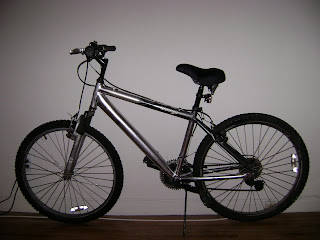
One really has to wonder if the subway is the best choice. For ~1000 USD ( MTA fare) a year, there has to be a more elegant solution to the problem of urban transportation. In comes the bicycle. This incredibly simple piece of 19th century technology suits the urban environment admirably. The bicycle is amazingly efficient, it takes roughly 30 calories to propel a person 1 mile on an average bicycle. If calories are converted into gasoline, the fuel efficiency of a bicycle(at 20 mi/hr) is around 900 miles per gallon! So a month ago, I decide to upgrade (or downgrade?) my transportation. I bought a used bike off Craigslist. This purchase turned into a major lesson for me. I locked the bike outside my apartment for a single night and it was promptly stolen! Undeterred, I went back to Craigslist the next day and bought another used mountain bike for 50 dollars. This time I locked the bike up inside of my apartment building, thus preventing any local hooligans from further attempts at theft.

The standard mountain bicycle is in many ways more suitable for an urban environment than "road" or performance level bicycles. There are a myriad of reasons. Primarily, because most cities are not very bike friendly, the machine must be robust enough to handle all kinds of terrain(pavement, brick, asphalt, lawn, sand..etc). Furthermore, NYC in particular doesn't really offer a very continuous bicycle path within and around the city. So when transitioning between bike paths, roads, and sidewalks, it gets rather bumpy. That is where a mountain bike's suspension system comes in.


I had to make a few additions to the used bike however. Frontal and rear LED lights had to be installed for night time journeys in traffic. A bell is also a must to alert pedestrians. When all was said and done, I had spent 80 dollars for the entire package, bike and accessories. A fully outfitted mountain bike is an enormously efficient machine to ride. Imagine a person running at full gallop, an experienced cyclist can comfortably ride at four times that speed, and keep it up for hours on end. On top of my souped up Quest Omega, the entire city opened up to me. Journeys that would've taken half a day on foot can now be accomplished within an hour. At a comfortable speed of 20-25 mph, I biked across the length of Manhattan island in just under 40 minutes. There were many points where my bike was going faster than cars. It is truly a wonder(perhaps an irony), that a muscle powered bike can exceed the performance of gas-guzzling cars in this city.

There are drawbacks however. When in bike lanes that share the same roads as cars, cycling can be a very dangerous activity. The issue stems from the fact that drivers of automobiles don't seem to give a damn about cyclists. Cars would park on long stretches of bike lanes, forcing the cyclists onto lanes reserved for other cars(thus increasing the chances of accidents). So while the bicycle pretty drastically reduces my dependency on the subway, it also increases my risk of a traffic accident. I think I'll need to practice some more before ditching my monthly subway pass! :P

Worm Compost Bin update


Our worm friends have been busy over the last several weeks. I have put in at least 20 lbs of combined paper and food waste within the last 3 weeks. The worms have clearly devoured much of the food. The lower layers of the compost bin has now been transformed into dark, rich compost. This biological process of converting garbage into soil is staggeringly efficient compared to the conventional method. The garbage goes through the "guts" of a series of organisms. The worms eats the waste, the waste of the worms is then eaten by tiny microscopic mites. The mites' waste is then consumed by eukaryote soil micro-organisms. It's waste is then consumed by even simpler bacterial lifeforms. The final "waste" product is the rich compost that serves as food for my herb plants.

I am now getting ready to harvest the bulk of the compost. It involves not feeding the worms for two weeks straight, and then separating the single compost pile into 2 piles(compost and remaining paper). If all goes well, about 5 lbs of rich compost could be expected.

Thursday, December 20, 2007

The urban biosphere is thriving!!!!


My tiny urban herb pots are doing rather well of late. As closed systems, the limited ecologies of these pocket sized biospheres has been unfolding with astonishing speed. In one pot, the English variety thyme has grown significantly larger. It's thin green tendrils reach towards the "sunlight" of my CF lamps. At the sub-surface layer, the worms are making a fine living tilling the soil. Every time I water the pot, some worms inevitable get flooded out of their subterranean dens. To my surprise, a least one other form of animal life has developed a niche in this pot. A population of tiny gnats seems to have colonized the canopy tops of the thymes. Under the lamp light, one can see dozens of them hovering above the thyme "forest". These animals are truly small, a fruit-fly would easily be 20 times larger.

The other pot seems to have developed a more diverse ecology. For one thing, the Arugula is almost entirely gone, edged out by the faster growing Oregano plants. The mint plants seems to be holding out against the Oregano. One notices an interesting dynamic between these two plants which are now sharing the entire pot biosphere. The Oregano plants are comparatively fast growing, but needs higher amounts of light input to maintain itself. Whenever the Oregano leaves encounter shade, the leaves will turn yellow after awhile. And then a kind of fungus will begin growing on the leaves. Shortly thereafter the leaves would wither up and die. Interesting enough, the Mint leaves can endure partial shade without any problems. However the Mint grows much slower than the Oregano. So after a few weeks, the Oregano had expanded to partially surround the Mints. All along the Mint/Oregano border, one can see the browned edges of the Oregano leaves. Strangely enough, if one looks very closely at the fungus on the leaf edges, you sees tiny mite-like insects eating the fungus. At the ground layer, one can see tiny sow bugs going to and fro. The worms are of course doing well here, they seem to survive adequately anywhere.

Sunday, December 02, 2007

More urban gardening and trendy conservation

My urban gardening system has been expanded this week. Now it includes an additional pot for growing English Thyme. The worms have multiplied significantly within their condo due to my generous garbage scraps. So to thin out the surplus population a bit, I have transplanted roughly 20 worms into each of the two herb pots. These little herb pots are in a sense like small islands or worlds unto themselves. Each pot has a relatively simple ecology with the herbs(as trees), the worms(as animals), and an assortment of soil borne micro-organisms. Aside from inputs of light and water, these tiny ecosystems are effectively cut off from the rest of the biosphere. The worm colonists themselves were fairly quick to scramble into the loamy potting soil. With such low numbers per pot, there simply isn't enough genetic diversity within the worm population to be self-sustaining. Thus new worms will have to brought in from the worm condo to periodically "freshen up" the gene pools of the Herb islands.

On another front, I have realized that a little known campaign in NYC to reduce the waste of plastic shopping bags have been wildly successful. Basically, a company took disposable plastic bags which were thrown away as garbage and recycled them into durable, re-usable "designer" shopping bags. These bags are then sold for between 1 to 2 dollars to trendy shoppers. I shelled out a dollar in hard currency and bought one of them. The bag was quite trendy-looking to be sure. But more importantly, they were very well made and held-up to heavy loads of groceries without any problems. Each designer tote has the carrying capacity of a large brown paper grocery bag. When in a hurry, an empty tote bag can be folded up into a pack smaller in area than a piece of printer paper folded in half. When shopping and looking around, I have noticed that there has been a recent surge in the usage of these bags. People apparently seem to be switching to trendy and re-usable shopping bags in very large numbers here in NYC. The average U.S consumer throws away about 30lbs of plastic bags per year, plastics, being a derivative product of oil, is a limited resource that should be re-used as much as possible. The trend of plastics conservation, if continued would be a very positive thing for the city and the country. To get your own "designer", re-usable grocery bag, go to EcoBags.

Sunday, November 25, 2007

Urban Gardening!!!

After many delays I have finally gotten on track with efforts in urban food production. Most "modern" cities aren't well known for being centers of food production. However, highly self-sufficient cities existed in numerous pre-industrial societies. The Ancient Mayans were well known for having garden cities where corn and beans were grown on temples and roof tops. The cities of pre-industrial China and Japan had a curious system where all "waste" in the form of effluence was collected and sold a valuable fertilizer to farmers within 20 miles of the city. Thus, cities with millions of people were literally eating their own recycled waste and eating well at that!

In this sense, modern cities such as NYC have been extremely wasteful. Hundreds of thousands of tons of organic biomass are thrown away each and every year to be buried in landfills. New York can just as easily recycle such valuable resources and convert them into food for it's citizen's to enjoy. To that end, my efforts have been two-pronged. On the one hand, most of my organic garbage in the forms of food waste/kitchen scraps and paper-based materials are being composted by an in-door Worm Condo. The condo produces valuable compost which are then fed to indoor(and hopefully outdoor) food bearing plants. Starting the planting process, I created a simple guild/poly-culture consisting of Oregano, Mint, and Arugula. 3 plants which supplies a food seasoning, a tea blend , and salad greens respectively. The 3 seedlings were transplanted firmly into a container which is roughly a foot in diameter and height. I filled the container with common potting soil and a small pinch of the freshly generated worm-compost.

And speaking of worms...these little critters have been getting quite comfortable in their new homes. They have been eating generous portions of kitchen scraps and paper wastes and producing large amounts of fine dark compost. It appears that some of them have decide to settle down and make babies. Worms are hermaphrodytes with very curious mating habits. 2 worms would begin the ritual by coiling with each other into a complex knot. Then more worms would join in until there is an enormous coil of a dozen or more worms. This worm orgy would writhe together for hours on end before splitting up. After the act, most of the worms would become pregnant with eggs since they have both fertilized and received fertilization from other worms.

Monday, November 19, 2007

The Worm Colonization


This weekend, I finally picked up the "worm condo" offered by the NYC Compost project. Basically, as part of the City's green effort, the municipal council made the decision to subsidize the distribution of home composting devices. After attending a 2 hour instructional session, a worm composting bin and a worm "founder" population can be had for $10 instead of the usual $50 price. The "condo" itself is a rather simple design. It's a large, rectangular bin made out of clear plastic, with a flat top lid and 4 aluminum-mesh, lateral, ventilation ports. An 8-inch deep layer of shredded newspapers are set down onto the bottom of the bin, this becomes the bed of the worm condo.

Under the light of 2 CF bulbs, I move the worms out of their tiny cardboard container along with a handful of their home soil. The little red worms were deposited onto the middle of the shredded newspaper bed. The worms began wriggling frantically under the light. They were palpably burrowing away from the light. They were heading in all directions into the shredded paper, creating a circular colonization wavefront of sorts. I can't help but associate this act of disembarking to a scene from some science fiction novel. A group of brave colonists, heading out of their generational spaceship onto an wholly alien planet, underneath the light of two suns.

My little colonists are of the red worm breed. The original stock of these creatures once inhabited the forest floors of central Europe. Their natural environment being a semi-damp carpet of dead leaves and twigs with scattered deposits of edible berries, nuts, and fungus. The ancestors of these worms developed the ability to metabolize both human-edible foods as well as cellulose. Due to the harsh demands of their Eurasian homeland, these hardy worms developed high disease resistance and quick breeding cycles.

In any case, after 3 hours, all of the worms have burrowed into the paper layer. The lights are then turned off, and the worm condo is deemed operational. The worm condo can compost a variety of wastes. Most biodegradable paper and cardboard scraps can be fed to the worms. Almost all food scraps can be deposited there as well. This particular condo has a capacity for processing 3 lbs of food wastes and another 5 lbs paper waste per week. Effectively, that is over 50% of my total weekly garbage output.


For all of you in NYC wanting to compost your own garbage, check out the NYC Compost Project

Sunday, November 18, 2007

The first frost

The first hard frost of the year had hit PA this weekend. The complex ecosystem of the garden was shocked into disarray, as I anticipated. Over the course of Saturday night, countless ice crystals pierced the unprotected cellular walls of non-cold adapted plants. After the frost, those crystals thawed out and the life fluids of the plant cells literally drained out of their bodies. The beans, tomatoes and eggplants collapsed into messy heaps by Sunday. My father collected the still developing eggplants, last of the beans and a basket full of green tomatoes. The remains of the plants were fed to the compost heap.

At it's closing 24 lbs of tomatoes, 3 lbs of white eggplants, and 13 lbs of beans were harvested. The garden life cycle as completed itself.


Monday, November 12, 2007

Cold fish!!!


This is turning into a very strange year. The above normal temperatures have extended the fishing season by a month or more. 56 pan-fish were captured over the last 3 weeks, yielding 38 lbs of cleaned meat and another 15 lbs of offal for the compost piles.

Thursday, November 08, 2007

Garden Update


The days have gotten much colder now.
Enclosed within the hemp mesh, my lovely little garden still produces!!!! The eggplants have finally grown up. The tomatoes and bean plants continue to bear fruit. 7 lbs of beans and 1 pound of tomatoes were harvested within the last 2 weeks.


Saturday, October 20, 2007

Massive Fishing Haul!!!!


It has been a glorious weekend for the reel. Under cold weather conditions, 64 pan fish were harvested. As an aside, 1 small mouth bass(8 lbs) and 1 carp(14 lbs) were also captured. After cleaning, 54 lbs of fish meat were put into the freezer, another 20 lbs of fish guts were applied to the composting piles.


Sunday, September 30, 2007

More food from Garden and Reel...

This past week has yielded a goodly amount of edibles. The beans are still holding strong, and so are the tomatoes. The onions are dying of the cold while the turnips and beets are thriving. All in all, 13 lbs of beans and 1 lb of tomatoes were harvested.


On the fishing front, my father went at it alone this weekend. The yield was not nearly as good as last week but still quite respectable. 15 large pan-fish were caught, after cleaning over 12 lbs of fish was sent to the freezer. The remaining offal was of course fed to the compost bin.