Saturday, July 07, 2007

The Potato Harvest and Friends!

I decided to head back to the burbs this weekend to harvest my potato crop. On saturday morning, I glanced at my organic garden after a 2 week hiatus in the city and saw a blend of the expected and not so expected. For one thing, the potato plants have more or less browned out, the later maturing varieties looking obviously healthier and less aged than the early maturing breeds. All 3 Potato varieties were ready for harvest. The Corn was looking gloriously vibrant, a dozen man-height corn stalks shot out of the square meter garden bed. The beans were not doing so well. Most of the beans have been damaged by potato beetles, for some reason the pests prefered to eat the bean leaves over potatos. Upon closer inspection, I realized that the native American Kentucky Wonder pole beans were almost entirely wiped out by the bugs, while the European pole beans were only lightly damaged. The discrepancy was glaring, it seemed that just about 1 out of every 2 beans plants have been reduced to skeletonized leaves. While the native American bean plants were all looking like the living dead due to these Eurasian pests, the Eurasian bean plants were only slightly pockmarked by the same beetles.

In short order, I got into the act of harvesting the potatos. It was moderately back-breaking work. Each potato plant was first yanked out of the soil with much of it's root structure. The smaller and moderately sized potatos usually came attached with the plants' roots, the larger potatos were at least dislodged. The individual potatos were collected, and the potato leaves/roots/stems carefully sequestered into it's own pile. It was of utmost importance to remove as much of the potato root structure as possible from the garden bed. The roots, if left in the earth, acts as a disease vector for potato family crops. However, it is also important to maintain the clover and onion ground cover on those same garden beds thus complicating the harvesting effort. After half an hour of harvesting, I had unearthed the entire potato crop.

The 3 breeds of potatos planted all had very specific individual traits. One can almost see the engineering trade-offs made as each variety was selectively bred by humanity. What traits were picked and which ones were discarded all depended on what the people were seeking in their environment. The Yukon Gold breed of brown-skinned potatos clearly scored highest on total yield(over 30% more than the other 2 types), but took weeks longer to mature and showed noticeably more susceptability to beetles and fungus. The Roten variety matured the quickest, demonstrated great pest resilience, and produced a good yield of big, red, and super-starchy taters . But those advantages were offset by the fact that each Roten potato plant was 30% larger than the other varieties, thus decreasing the total number of potato spuds that can be efficiently planted on the same surface area. And then there was the Kennewick breed, it was relatively slow maturing, it's yield was the lowest, it showed the most pest/fungus damage of all. To top it all off, the potatos seem to grow really deep under the plant structure, thus making it a pain to dig out. However, there are redeeming qualities to the Kennewick. These pale white potatos are, without exception, very well proportioned(not too big or small), unlike the other breeds. The Kennewicks are also possessed of this very smooth, almost tender white skin that contrasts very sharply with the rough and thick skins of the Yukon Gold and the Roten. One could almost imagine that the Kennewick variety may have been selectively breed as some sort of elite status food. I gathered up the potatos and put them onto a flat bench in my garage to dry off. After half a day of drying, those potatos can be put into the cellar and kept for many months. All in all, the yields were 31 lbs of Yukon Gold, 23 lbs of Roten, and 19 lbs of Kennewick, a total of 73 pounds of potatos cultivated from 2.5 square meters of earth.

With the potato harvest completed, I decided to see if I couldn't recoup my bean plant losses. After seeing the selective damage done by the Japanese beetles, I launched a genocidal campaign against these bugs. Gloves in hand, I combed through the entire garden and killed every single Japanese beetle that I found. I gathered hundreds of their tiny corpses in a cup, mixed in a bit of water and grounded them into a fine paste. Most of this liquid fertilizer, I dumped into the compost mounds, but some of it I saved for what I had in mind. I quickly replanted European variety pole beans at the sites of the dead Native American bean plants, And to jump start the bean growth process, I added some of the diluted beetle puree to each bean seed as I planted them. As the beetles have so heartily fed on the defenseless beans in life, so shall they, in turn, be feed to the beans in death. As I was doing this, I harvested about half a pound of pole beans, 2 fallen green tomatos and a pound of green onions.


With the bug-fighting campaign out of the way, I started working on my hot composting bins. Taking the 2 potato growning containers, I methodically applied a layer of dirt followed by a layer shredded potato plants/lawn grass/leaf clippings/kitchen vegetable clippings for some 4 iterations per container. After which, each container was given a cups of diluted urine to jump start the decomposing process. Finally gallons of water was applied to each compost bin, and then both bins were covered with hemp fabric to keep it extra warm and toasty inside. Last summer I was able to see some luminous biomatter coming from the compost bins during the hottest summer months. This year, I plan to get a few snapshots of it. So it was not too bad for a day's work in the garden.

Sunday, June 17, 2007

More Food and Organic Garden Update!


Today, about 1/2 pounds of green onions were harvested from the garden. The Onion greens can be harvested continuously through the summer and early fall. After which the underground Onion tubers can be extracted with a final harvest. I had intended to plant some more herbs such as basil and thyme, but didn't quite get the time to do so. In the rest of the garden, much has transpired. Almost all of the crops are flowering, making the garden look like a giant series of flowering bushes.


The early and mid season potatoes will be ready for harvest within 2 weeks. The late season potatoes will be ready within 4 weeks. The idea here is to stagger the planting of a secondary crop of potatoes into 3 phases, which would result in another 3 harvests later this year. One troubling thought is the effect of the potato harvests upon the surrounding bean plants, since the beans have formed a symbiotic relationship with the potatoes, the removal of the taters may make the beans more susceptible to pests.

The crop trinity in Garden Bed one is doing very well, the Eggplants are flowering profusely and will soon bear fruit. The pole beans have climbed up each and every corn stalk and are also flowering like crazy. Everything is so tightly integrated that this network of crops looks as if it's a single, complex plant. The corn stalks have sent up strong stalks with broad emerald leaves, the beans clamor along the sides of those stalks, and the ground beneath is entirely covered by eggplant leaves, not a square inch of sunlit space is wasted by this system. The corn/bean combination I think can be left there until the end of the agricultural season this year. The beans will produce until October, and the corn will be ripe by then as well. The eggplants after the august harvest may be turned under the soil and replanted with either sugar beets or winter kale. I plan to seed Garden bed one with some other leafy vegetable combination next year, and if the gods are kind, another intensive crop of potatoes the year after to form a full rotation.

Sunday, June 10, 2007

Garden update and First Harvest!!!!

Today, we harvested the lettuce heads from the garden. They have developed into very large and tall green structures, replete with rich green leaves. Of the 9 saplings that I started indoors, 6 of them made it to the garden bed, and 5 of which survived into maturity. Each head of lettuce is between 2 to 3 pounds in weight. Overall around 14 pounds of lettuce was harvested. The lettuce heads were quite leafy, and free from much pest damage. Apparently, the dragon flies have really done their jobs over here. The surprising point to note here is that the overall space that the lettuce took was about a quarter of a garden bed, or roughly .25 square meters. There is perhaps more than a month worth of salad greens here for one person.


The area in garden bed 2 that was previously devoted to the lettuce crop was immediately sown with an Northern Indian variety of Lentil seeds and covered with leaf mulch to conserve moisture and to prevent soil erosion. The lentils will mature and yield a continuous harvest through summer and early fall, after which it'll be turned over and replanted with beets and/or turnips for an early winter harvest in November. Thus a continuous and intensive flow of foodstuffs out of the garden can be provided from March to November. What is more miraculous is that such a small area of soil will be able to maintain it's fertility while producing so much food.

In other areas of the garden, several crops are getting ready to produce. The Onions will be ready for a continuous harvest within a week. The early maturing Roten Red Potatos will be ready for harvest within 2 weeks. All of the potatoes will be harvested within 4 weeks and a second potato crop would need to be sown for an early October harvest. The tomato plants are producing dozens of small green tomatoes at this point. Maturation of those tomatoes will occur beginning in July, thus providing a continuous tomato harvest until early October. The beans, I'm not expecting to see a crop until mid July at the earliest. The eggplants will be even later.

Now that my organic garden has entered it's primary production phase, I have been expecting a good deal of damage from the usual depredations of marauding children. And so far they have not failed to live up to expectations. Several days ago, someone passed by the garden and tore up 2 corn plants and incurred significant damage to 3 potato plants. Thus 10% of my corn crop is now lost. It was obvious that this person had intended to kill the potato plants as well. One thing that I have observed however is that Potatoes are extremely hardy, within 3 days, the significant leaf damage done by the trespassers have been completely repaired by the plant itself, all 3 of the damage potatoes have fully recovered. For the gaping areas left by the corn plants, chick pea seeds were immediately sown as a cover crop and leaf mulch applied at once. The chick peas be ready for harvest around August. There needs to be some measure of security for the garden to prevent future human raiders.

Saturday, June 02, 2007

A mid-summer night's post


It has been a while since my last post. Much has happened in the meantime. I moved into a major city and started some indoor miniature gardening efforts there. I came back to the suburbs today to check on my organic garden beds. It appears that much has transpired in the last 3 weeks. The garden is at last beginning to resemble a miniature jungle, complete with a multi-tiered vegetation canopy. There has also been a degree of pest damage in some areas, but nothing too severe.


Garden Bed 1 has developed into a robust crop "trinity" system. The corn stalks have grown up very well. The pole beans are sending intricate tendrils up and around the cornstalks, using them as a living support structure. The eggplants have grown much larger as well, spreading out to cover most of the exposed surface area between the beans and corn plants. The entire "design" is incredibly efficient. The corn supports the beans by providing a super-structure, the beans support eggplants and corn by fixing nitrogen into the soil, and the eggplants serve both corn and beans by providing ground cover which conserves soil moisture. What is more amazing is that corn, beans, and eggplants, provide carbohydrates, protein, and vitamins respectively: the necessary components of a complete nutritional diet. The corn and the beans are remarkably free from disease. However, upon closer examination one can see that the eggplants have suffered a degree of damage from black flea beetles. All of the eggplant leaves were perforated with small holes made by the beetles. The significance of the damage seems to have been mitigated by some dragon flies. These young dragon-flies were hovering like attack helicopters over the eggplant leaves, every once in a while one of them would swoop down and capture a flea beetle for lunch.


Garden Bed 2 is developing along similar lines. The tomatoes have grown to be twice as tall as they were during my last post. The Lettuce heads have developed into huge(basketball-sized) plants, they should be ready for harvest within several weeks. The pole beans have grown up and around the bamboo and metal scaffolds, as well as around the tomato plants themselves. The onion chives have grown to be over a foot tall. The tomatoes, pole beans, and onion chives seem to be flowering at the same time. As such, large numbers of bumble and honey bees were flying around Garden Bed 2. Overall, there does not appear to be any significant pest damage in Garden Bed 2.

Garden Beds 3 and 4 have turned into complete jungles. The Potato plants in those beds have grown to be over 4 feet high. Pole beans have managed to climb up every single bamboo support pole, and several of the potato plants themselves. Large portions of the ground layer of both beds seem to be carpeted by lush green onion chives blades. Both of these beds have become edible jungles of sorts. The potato/bean/onion combination seemed to have warded off a great deal of pest damage. I'm seeing the usual assortment of pest insect characters, but their effects have so far been quite minimal upon these two beds.

As I'm writing this entry, I can't help but marvel at the incredible level of bio-diversity that has developed in this "perma-culture" garden . Last year, I was impressed that there seemed to be several times more insect species in the one garden bed than generally found on the lawn. This year, there seems to be an order of magnitude increase in the variety of insect species found in my garden. It is particularly contrasting as this side-by-side picture demonstrates between the jungle-like organic garden and the savanna-like lawn.

I looked at every tier of the canopy system, and took careful notes of the species seen there. And here is what I found:

Ground Surface Tier
Centipedes, Pill Bugs, Mole Cricket, Snails

Ground Cover Tier (onion chives, green onions, herbs)
Caterpillars, Grasshoppers, Ants, Praying Mantis, Weevils, Fireflies

Intermediate Canopy Tier( Cabbages, Potato/Tomato stems, Bean tendrils)
Potato Bugs, Japanese Beetles, Fruit Worms, Moths, Army Worms, Spiders, Soldier Bugs, Lady Bugs, Orius Bugs, Cucumber Beetles, June Beetles

Leaf-top Canopy Tier( Tomato/Potato/Eggplant/Pole Bean leaves)
Aphids, Flea Beetles, Gnats, Green Lacewings, Flies, Leaf Beetles, Dragon-Flies, Honey Bees, Bumble-Bees, Wasps, Fruit-Flies, Leaf Hoppers, Leaf Worms, Midge-Flies

A total of 37 insect species were easily identified in a Garden whose total surface area is barely 6 Square Meters. Conversely, I did a similar examination of the mowed lawn just a few feet away, and came up with a total of 3 insect species(ants, grasshoppers, fireflies). Such a disparity was quite shocking to me. The lawn, in ecological terms, is akin to a barren desert compared to the Garden.

Imagine this, we spend precious fossil fuels in the forms of chemical fertilizers, pesticides, and lawn-mowers to create a nearly life-less desert in our backyards. The lawn produces nothing, but takes constant and massive amounts of energy to maintain. We should all be trying to turn our backyards into garden ecosystems, free food and an abundance of wild-life beats wasting gas and money any day of the week!

Friday, May 11, 2007

First fishing trip of the year


We started the fishing season a bit late this year. Though for a first showing, the catch wasn't half bad. This time though, all of our bait(worms and tiger beatle larvae) was dug up from the the compost heap. The breeze was warm and the water temperature quite comfortable. After an hour of steady reeling, we caught 6 bluegills, 2 sunfish, and 1 pumpkinseed. The fish were quickly gutted and the offal preserved. The offal represents a valuable soil enrichment resource that had previously been untapped. In anycase, the fish guts were carefully buried underneath a layer of packed soil within the compost pile and then topped by 2 additional layers: one of leaf and another one of packed grass clippings. This would eventually decompose into an extremely rich grade of compost, though it could also be quite smelly. Thus, another cycle has been created where the compost pile generates bait which generates fish which generates even richer compost!

Thursday, May 10, 2007

The flourishing crops!!!!


Over the last week, the organic garden has experienced incredible growth. This could be due to a combination of warm May weather and the copious amounts of organic compost that has been applied into the garden beds. Though I happen to believe that this confluence of positive growth conditions cannot last for long, either bad weather or a pest outbreak will surely slow down the crop growth. In anycase, Meso-American cultures 500 years ago probably would have been worshipping their corn god for such good fortune at this point.


Indeed the effect seems most evident in last year's garden bed. After the application of some 20 lbs of compost along with the turning over of turnip and bean roots, the soil is possessed of a loamy texture and rich dark colour. The beans that I planted grew quickly into broad shoots in just over a week. Last year, the same level of growth did not happen until late May. The corn saplings also sprouted after just 7 days when a normal span of 12 days had been expected. The eggplants in the same garden bed had been suffering an attack from flea beetles. However, just yesterday I spotted a dragon fly perched on top of one eggplant hunting the flea beatles. This play upon the original "Three Sisters" crop combination may even end up working!

Garden Bed 2 has seen a great deal of growth. The tomato plants have firmly established themselves in the soil and have begun to flower in earnest. The surrounding pole beans are all sprouting, though not as profusely as in Garden Bed 1. The lettuce plants have recovered entirely from their ordeal last week. Now small, leafy heads of lettuce are beginning to take shape. I had been expecting some sort of slug infestation, but nothing of the sort has been happening. It seems that just about everything in Garden Bed 2 is thriving, including the weeds. Weeds of all sorts seem to be coming out of the every clump of soil. After pulling handfuls of it out of the soil, I woke up the next day to find fresh new weeds spring up all over the place. So far the weeds do not seem to be inhibiting crop growth, but one must be vigilent.

Garden Bed 3 and the Potato containers are both doing very well. The potato plants this year has been fast growing and surprisingly devoid of pest damage. This could be due to close planting of the seed potatos with pole beans. I read from One Straw Revolution that closely planted beans and potatos confuse the pests that attack each respective plant. The mistake made last year was that the beans were planted next to a homogenous block of potato plants rather than interspersed amongst the potato plants. This allowed the viscious Japanese beetles to home in to those potatos farthest away from the beans. To ensure a working bean/potato combination with the container grown spuds this year, I had sown pole bean seeds immediately along the sides of the 2 containers. If the potatos plants do well, I'm expecting to at least triple the amount of potatos harvested over last year.

Garden Bed 4 has probably shown the least amount of growth of all the garden beds. Coincidentally, the newest garden bed also had the least amount of organic compost(10 lbs) applied to it. Effectively, the soil of this bed most resembles the unmodified soil of a lawn: hard, yellow, and clay-like. All 6 potato seeds planted there have broken the surface, but one can clearly see that each of these potato plants are much smaller than there brethern in bed 3 and the containers. Nevertheless, after a few more years of building up the soil, this bed will be as fertile as the rest!

Monday, April 30, 2007

Spring Gardening Update


Spring has finally arrived in full force. Fortunately, I am off from work for the next 2 weeks, which means way more time for the garden! Two consecutive days of 70 degree weather has done wonders for the garden. The ailing lettuce saplings, which had barely survived transplantation, is making a comeback. The main trunk of the plant, having been elongated due to being confined in the transplant pot for too long, as thickened considerably in the garden bed. Oddly however, the main growth of the lettuce now seems to be occuring at the end of the trunk not at the base of it. This may cause developmental issues later on in the plant's life cycle, but for now I think the coast is clear.


Of the 14 potato spuds planted, 11 has sprouted. This is a significant improvement over last year's results, where the spuds first began sprouting in mid-may. The early maturing Rotten Red variety had all sprouted vigoriously in garden bed 3. The middle maturing Kennewick potatos all sprouted in the containers, though not nearly as abundently as the earlies. The late maturing Yukon Gold potatos are just beginning to break the surface, some 3 of the 6 spuds have so far sprouted in garden bed 4. If all goes well, 4 successive harvests of potatos can be expected this year: early, middle, late, early. Along with the potatos, the chive plants are flourishing with emerald green blades going everywhere. The scallion seeds have also germinated, sending tiny shoots up through the earth. On the other hand, turnip seeds sown a month earlier had not germinated at all, I surmise that unpredictable weather over the last month was the culprit. In anycase, I set down some pole bean seeds into the turnips' area in garden beds 3 and 4.

I planted 2 tomato saplings of different varieties(Beef Steak and Early Girl) onto garden bed 2 several days ago. These seems to be doing very well and have even attracted some bumble bees into the midst. To support the growing tomato plants, I erected a scaffold and tied both plants to the scaffold via some hemp cordage. 5 of the 6 transplated lettuce plants had managed to survive the last 2 weeks. Around the tomatos and lettuce saplings, I set down an even mixture of Kentucky Wonder and European pole beans. I chose the 2 varieties to maximize genetic diversity(and provide increased protection against disease).

Garden Bed 1, the square meter garden last year, was sown densely with a mixed corn and pole bean combination. There were two varieties of corn(Mesoamerican and Chinese) and beans(Kentucky and European) Additionally, I transplanted 2 Eggplant saplings of mixed heritage (West Asian Black Wonder, and Japanese Round). The purpose of such diversity is protection against microbial diseases and insectile pests. By bring diversity of species, and diversity within species, pests would have a very hard time adapting to all the vareities available. Thus pest populations never reach the numbers needed to ruin the entire crop. In a permaculture garde, as in nature, even pests have a place, though not a dominant one.

Saturday, April 07, 2007

The Planting begins!

This afternoon, I transplanted 4 potato buds into the 2 containers that had so recently served as my composting bins. I chose the early maturing Kennewick variety for the containers, a harvest should be ready by late june if all goes well. The usage of double cropping will allow these containers to produce two potato harvests this year. Additional composting from now until the end of summer will be done entirely in the leaf composting area that was constructed last autumn. I re-grouped the leaf compost heaps into 2 larger heaps. One such heap will be used for the hot/active composting that the bins were used for.


In addition to the potatos, I set down 2 rows of turnip seeds on Garden beds 2 and 3. The turnip is a wonderful crop, every part of it is edible. When the turnip seeds were sown, I decided to go ahead and plant out some green onion seeds in garden bed 3. An organic garden survives due to it's diversity of life, and diversity also means a niche for the pests. No bio-intensive food producing system can avoid losing a share of it's produce to pest species. The point is to develop a miniature ecology in such a system that is resilient enough to keep the pests under control through predation and disease.

A truly resilient garden system thus resembles somewhat that of a rainforest. You have tall crops(tree canopy analog) to provide shade and the necessary support structure for a complex ecosystem. Then comes the medium height crops(bushes/shrubs analogy) to grow alongside the tall crops, usually these crops somehow support other crops through soil enrichment or pest control. Lastly you have the low-lying crops(grass/flower analogy) , these crops are grown around the "canopy/brush" and fills up the garden bed. A typical set up is the "Three Sisters" combination: Corn(Trees), Pole Beans(Bush), and Squash(grass). I plan to turn Garden bed 1 into a trial bed for the Three Sisters combination.

And speaking of miniature ecologies, it appears that a very simple one has evolved within my sapling "jungle" indoors. The cabbage saplings have been doing extremely well and now towersabove the onion chive saplings. Upon a routine examination of these plants, a minature world was discovered. Apparently, the cabbage saplings have been serving as a canopy of sorts. Scores of tiny flying herbivores were ascending out of the chives to feed upon the lettuce leaves. Perched upon one leaf of lettuce was a mature soldier bug. One could see the simple hardwired logic of the predator as it climbed endlessly around the lettuce plant eating one flying pest after another. This is almost as entertaining as one of those nature shows on the discovery channel!

Sunday, April 01, 2007

Seed Preparations and Garden Planning


On sunday, I began the process of preparing seeds and saplings for sowing/transplanting into the newly expanded garden. The turnip seeds, being rather cold resistant, were sown outdoors this morning. Next on the list were the onion chives and lettuce saplings. These little beauties have been growing indoors for a week and are now much bigger than when I first picked them up. The chive plants already show signs of emerging flower buds. The last spring frosts are supposed to be completed by mid April, so these plants will have to mature indoors for another week or so before the transplant. As an added benefit to early maturation, indoor growing pre-empts unnecessary damage by birds and pests. There really is much to be said about the saplings. These little biological machines assemble themselves out of thin air, powered only by sunlight. Since I used heirloom seeds, each sapling is widely unique from others of the same breed. This is in stark contrast to the supermarket variety of lettuce heads. There, nearly every head of lettuce looks very similar to every other head of lettuce in the same section. This level of uniformity is achieved due to their identical genetic structures, a very clever use of cloning!

Next after the saplings are the potato buds. I chose three breeds of Heirloom Potatos: Kennewick, Red Norland, and Yukon Gold. These breeds cover the range of early, mid, and late harvests, respectively. Potatos and Corn will be the bulk harvest of my garden this year. Thus hardiness and disease resistence were choosen as the most desirable traits in these buds. These potato buds were separated into three bags and kept near warm places to encourage sprouting. They will be planted into 2 garden beds and 2 containers next week for 3 successive harvests in June, August, and October. After doing some research on which potato breeds to plant, I learned some interesting facts about the modern potato industry. Currently about 2/3 of all potatos consumed in the U.S derives from a single breed called Golden Wonder(GM). This particular breed was originally selected for it's high yields. But at some point in the nineties, 2 important changes were made to it's genetic structure. Firstly, a small snippet of DNA from a certain fungus was inserted into this potato's genome. This little change resulted in a poisenous insecticide-like effect to potato beetles when they try to feed on these potatos. This change was fine and dandy,except that the FDA wouldn't allow a genetically modified crop to reach the market if it could potentially spread it's genes to other none-GMed breeds of potato. So as a result, they made another tweak. The growth inhibitor gene of the Golden Wonder potato buds was switched off, these potato plants became unable to reproduce as a result. Thus, when we go to McDonalds, those french fries that we're eating is, in effect, both part insect-killing fungus and also sterile to boot.

In anycase, perhaps it's best to take a lesson from Masanobu Fukuoka's Permaculture treatise The One Straw Revolution. The lesson is that the wise permaculturist should select in his/her crops the one trait which nature itself selects for: the ability to live on.

Saturday, March 31, 2007

Garden Expansion Update!


I finally managed to obtain some seed potatos today at a rather remote Agway near Lancaster. Three different potato sub-species were obtained to create 3 successive harvests stretching from june to october. Interestingly enough, less than four centuries of selective breeding by Gardeners had managed to produced dozens of potato breeds. Each one adapted to a particular growing region. In the colder regions, potato strains were selected for the ability to mature quickly in the short growing season. In warmer areas, traits such as higher yields and disease resistence were more favoured by pre-industrial farmers. On the way home, I picked up some peat moss to provide drainage for the 2 potato growing containers.

Saturday afternoon was spent with the Garden expansion process. Two additional garden beds were hacked out of the lawn. The work was of course very tedious. At times there seemed to be more rocks than there was dirt. At a certain point, I could no longer extract the mischievous stones with the shovel, so I called my father out for some "father-son bonding!"

Of course by bonding, I meant mutual participation in back-breaking manual labor. The large fist-sized rocks, I removed with the trusty pick-axe, while my dad shoveled out the loosened soil. Two hours and 50 pounds of compost later, we were finished. While much has been written about the hardships of peasantry, one has to comment upon the flip side. There is so much innate joy in creation, even if it involves just a few garden beds. We had turned a large stretch of grass into the beginnings of a huge organic garden. A large block of suburban monoculture has been transformed into a canvas of sorts. A canvas in which a tapestry of life and happiness can be cultivated. Isn't saving the planet fun?!!

Sunday, March 25, 2007

Massive Garden Expansion Underway!

Over the winter, I've finally convinced my family of the value of organic gardening. A single 2 square meter plot had managed to produce over 100 lbs of food last year using permaculture methods. As such I got the go ahead to expand the area of my little gardening experiment by four folds. So on sunday, I made a go at it. And it was rough going to be sure.

First the old plot had to be enriched. The two square meter plot was dug up to a depth of some 6 inches. The top soil was collected into a huge pile besides the plot. Then a layer of leaf mulch weighing some 30 lbs was packed into the plot and beaten down with the handy shovel until it was compressed firmly along the ground! Now this technique accomplishes two things. The packed leaf mulch(which had been composting since last november) provides a hard base with which weeds will have trouble breaking through. Additionally, over the coming months, worms will eat through the decomposing leaves and return the nutrients back into the soil, adding to the amount of top soil on that plot by several inches. After this was done, the removed topsoil was mixed with 40 lbs of black organic compost(half a bin) which had been sitting in the 2 composting bins for the last 9 months. This blended mixture was then applied back into the packed garden bed. The resulting garden bed was then lightly tilled to an even depth of 8 inches of topsoil/compost mixture. This took some 2 hours of hard digging and tilling.

After a short lunch break, I began the construction of a second garden bed. The progress was quite slow. Each and every shovel brought forth a broken piece of turf about 6x6 inches in area. The square of turf had to have it's attendent sod shaken out by hand. The sod is of course valuable top soil that needs to be collected to build the bed. At the end of all the extraction, the piece of turf was just a tangled mass of grass and roots with a little bid of soil left. Under the hot sun, the manual labor was quite exhausting. This de-turfing took over an hour and resulted in some 30 pieces of turf along with it's attendent soil. Then came the painful process of digging up the actual bed. Some six inches of soil had to be removed from the garden bed. That translated into over 60 lbs of top soil. Unfortunately, the geography of the Northeastern U.S dictates that the soil be rocky as all hell. A single 2 square meter garden bed yielded over 20 lbs of rocks(lodged in hard to extract angles) which had to be tediously levered out with the trusty spade.

After the top soil had been extracted into a nearby pile, the packing begins anew. Instead of wasting the valuable turf, I chose to put it towards good use. Take a piece of turf and turn it upside down, there's exactly enough flipped turf squares to cover the garden bed. This packing accomplishes 3 things at once. Firstly, it inhibits weed growth. Secondly, it attracts beneficial organisms such as worms and arthropodes. Because the upside down turf dies within a day, that entire layer becomes in effect a compost pile. Both worms and centipedes eats the decaying matter and produces valuable organic fertilizer. And lastly, the packing of the turf inhibits one dangerous organism, the tiger beetle larva. These little critters specializes in the consumption of living roots. The turf, once flipped and packed, can no longer serve as a viable food source for them. Thus, within a week or so, all the tiger larvas must either move away from the area or starve to death. After the packing was finished, I spent another hour mixing the extracted top soil with the remaining half bin of enriched fertilizer with the handly rotational plow. After the mixing, there was only some nitrogen rich sludge at the bottom of compost bin number 1, I had exhausted 50% of my compost supply with the 2 garden beds. The soil/compost mixture was then placed back onto the packed bed and roto-plowed to break up the larger lumps of soil. After this step, the bed was tilled to an even depth.


The 2nd bed took over 4 man hours to construct from start to finish. After the deed was done, I drove to the local Agway to buy some heirloom saplings which had been started off in green houses. Vegetable/flower saplings, thus started, could mature earlier and produce food several weeks earlier than normal if transplanted into the garden beds. While there I picked up some onion chive flowers and cabbage transplants for 4 dollars of hard currency. These saplings I'll have to keep indoors for another 2 weeks before the transplant can occur. Here in PA, killing frosts usually dissapear after mid april. That's it for this week. Next week I shall begin the construction of two new garden beds!

Sunday, March 18, 2007

Energy Efficient Light Bulbs!


After much heated debate last month, my family had finally allowed for the replacement of every incandescent light bulb in the entire house with an energy efficient Florescent or LED light. If one considers the unstable and diminishing nature of our world's energy supply, it makes much sense now to become as efficient in the ultilization of electricity as possible. A gradual "power-down" through more efficient and sustainable technologies is much preferable to an abrupt crisis in energy services. If our civilization is to last the ages with our culture and technology intact, it is of paramount importance that every individual do their utmost to conserve our valuable supplies of non-renewable resources.

It is thus worth mentioning that an NVision Florescent bulb can deliver the illumination of a 60 Watt conventional light bulb while consuming only 14 Watts of electricity. So we replaced some 24 light-bulbs in the house with this efficient bulb. And this month, vindication has arrived in force. Our monthly electric bill has been slashed by over 40 percent! My goal is to reduce the house's total( grid-derived) electricity usage to 1/3 that of the usage volume last year by 2008.

Saturday, March 17, 2007

Grand Canyon Expedition...Part II


So the next day, we decided to take a trip to the Indian Ruins at Tuyusan. Now, it is without doubt that the environment of the canyon is rather inhospitable to human life. There simply is not enough rainfall here to support large populations of either human or animal life. The geography of the region is also rather daunting, it's filled with steep ravines, deserts, and mesas. In fact, the immediate surroundings of the canyon somewhat resembled the past martian landscapes that one reads about in science fiction novels. I can imagine just how difficult it would be to transport raw materials and goods across even short distances here. For stone age peoples, a high material culture would hardly be sustainable from such a barren resource base. Yet, the Pueblo tribes that inhabited this area in the 1600s were inheritors of considerable cultural sophistication.


When European explorers first reached the area, they encountered groups of Pueblo dwelling tribes which, among others, included the Hopi, the Zuni, the Navajo, and the Hosni. Now these tribes built relatively sophisticated multi-level buildings from sun baked mud and stone. Their pottery and jewlery making technology was literally centuries ahead of the tribes around them. But the most interesting technology was that of the solar calendar. These primitive peoples built a solar calendar out of stones and used that calendar to synchronize their plant growing seasons. Now, sophisticated pottery and precise solar calendars don't usually come to primitive stone age tribes, actually they almost ever do. But in the case of the pueblo builders, their material culture benefited from a neighboring high-culture that has unfortunately dissapeared from history.

Some 1000 years ago, the landscape of northern Arizona was a bit wetter than it is now. South of the modern day Pueblo builders, there existed a high culture of great sophistication, the Anasazi. Now the Anasazi built large cities fed by spring water. Their original center at Chaco Canyon had enormous forests of cedar trees. With such a resource base, the Anasazi had the material wealth to build up their culture and technology. Over centuries, their cities and settlements expanded in all directions until they reached the Grand Canyon in the North, and the salt river in the south. Their agricultural system was of course entirely unsuitable for the environment that they lived in, but during that period of benign conditions, their unsustainable methods would've produced the kind of manpower that allowed them to expand their culture far and wide.

In anycase, the Anasazi civilization eventually expanded to dominate the tribes of the Grand Canyon. In the process of expansion, they gained the resources to develop a stratified society of priests, kings, craft specialists and peasants. It was during these period of growth and expansion that the "advanced" technologies such as gold/turquoise jewlery, slipcast pottery, solar calendars, and multi-level buildings were developed. It was also during this time that the Anasazi elite gained a taste for treating themselves to the benefits of "civilized" society. Benefits such as huge palaces and temples with scores of rooms, expensive jewelery with thousands of precious stones, and of course, lots and lots of slaves.

Needless to say, the Pueblo cultures supplied the Anasazi hegemon with timber, chert, turquoise, goats, slaves, and other natural resources that the Canyon provided. In exchange, these tribes gained a measure of the cultural and technological sophistication from their southern neighbors. Unfortunately, the Anasazi completely deforested the areas under their immediate political control. The trees and shrubs which had served the vital purposes of water retention and soil enrichment were largely gone by the 1300s.


When the severe droughts of that century hit, the Anasazi high civilization collapsed into anarchy and cannibalism. Within a generation, the Anasazi were gone. Their cities and temples remain as a silent testament to their greatness...and foolishness. The pueblo cultures survived the disaster however. By using a combination of sustainable dry bed agriculture, hunting, and gathering, they weathered the massive climate change. By keeping their population in check, they never deforested their environment to the point where water retention became impossible. In the wake of the Anasazi collapse, the entire region swept into a kind of dark age. Tribes of cannibals from the plains states to the north swept down the now depopulated region and devastate the few surviving settlements. The Pueblo cultures largely survived the ordeal due to a combination of their harsh environment and superior technology. While there is much to be said for greatness and ambition, it would appear that in the case of this area, humility translates into long term survival.


When I picked up some local pueblo pottery from the Indian gift shops, the sophistication of the culture that inhabited this land a thousand years ago really stood out. It is up to us to make sure that our culture doesn't suffer the same fate as that of the Anasazi. Perhaps a degree of long term consideration should be factored into our daily decisions. This has been a very educational trip indeed!

Monday, March 12, 2007

Grand Canyon Expedition....Part I

During the deepest months of winter, a good friend and I planned a journey to the Grand Canyons of Arizona . As such, we made good upon that plan and flew to Arizona last friday. Aboard a jet aircraft, some 2600 miles of North American continental vastness was bridged in 4 hours. Upon arriving at Phoenix, I was quite surpised by the vastness of this city. Of particular contrast, was the lush(almost tropical) city scape when compared with the semi-arid desert which surrounded the metropolis. I saw a series of well maintained canals which undoubtedly supplied the city's million or so inhabitants with potable water. Of particular note is the fact that the canal network was originally built by the pre-literate Hohokam culture. That group of people, through a centuries long construction effort had enabled the Phoenix area to be inhabitable in the first place. Unfortunately Hohokam society unraveled and perished due to the decade long droughts which hit the region in the 13th century. Basically, the canals dried up, Hohokam agriculture collapsed, and their society soon followed.


In anycase, we drove some 270 miles across the desert Friday night. We passed the night in the small town of Williams. On Saturday morning, another 60 miles of barren desert and scrubland was crossed to reach the Grand Canyons. It dawned upon me that the desert effectively served to isolate the early Native American societies of the region from each other. This must have been a great inhibitor on the spread of ideas and technologies between the various regional tribes. It is doubtless in my mind, that the indigenous peoples of these lands must have been extremely clever and adaptable to have survived at all in the harsh landscape. But I do surmise that the isolation of the desert prevented the emergence of a literate, high civilization in these parts.


The Grand Canyon was of course as awe-inspiring as the advertisements promised and more. After some preparations we began our hike down the cliff-side to the bottom of the Canyon. The trail was of course narrow and quite slippery at certain points. The Canyon floor, some 5 miles away, was approached at a steady pace of 2 miles per hour. Along the way, we encountered many other hikers going in both directions. The Canyon cliff top where we started is a vetical mile above the canyon floor. Thus, as we descended upon these heights, the surrounding climate and vegetation began to change very significantly. The cliff-tops were predominantly alpine in nature, but the vegetation gradually transformed into a kind of bushy scrub as we went lower. The temperature of rather cold at the top and of course got higher as we went ever downwards.

Along the narrow trail, there was a rather constant stream of dung and other wastes emitted by the mule teams that walked up and down the canyon. At the higher elevations, this was rather endurable since the lower temperatures kept the smell down to a minimum. Near the valley bottom however, the scent of mule dung permeated the entire trail. In some areas, the dung was grounded into a fine greenish paste which was subsequently sun baked into a distasteful(literally) powder which of course was carried everywhere by the dry wind.

Along the trail, I noticed several rather interesting cliff-side paintings. Of worthy mention, was one such portrait depicting the pursuit of a mountain Ibex by several paleolithic bowhunters.
Of course these hunters belonged the little-known Mogollon culture. The Mogollon tribesmen of this region were of the hunter gatherer type found in so many other primitive cultures. They hunted mountain Ibex, collected berries, and lived in the hillsides. When the droughts of the 1300s hit, their small populations were significantly impacted. Their enviroment effectively collapsed. When the droughts finally ended, a new tribe of part-time cannibals(whose descendents were destined to become the Apache, Kiowa and other plains tribes) migrated here from the northern grasslands and effectively wiped out the remnents of Mogollon society. Coincidentally, the mountain Ibex prey of the Mogollons has outlasted their hunters by some 700 years.

And speaking of the Mountain Ibex, never in my life have I seen a breed of goats as fluffy and lovable as these. In fact we bumped into several of them along the trail. They would come to within a few feet of us and just stand there. I surmised that they were begging for food or candy of some sort. In anycase, these goats had hooves that looked like tiny claws which effectively allowed them to grab onto small stones and bits of turf along the cliff sides. These goats were able to nimbly scale up and down cliffsides with the kind of speed and agility that no human could match.

After 2 and a half hours of hard hiking we came down to the valley floor. It was more or less a desert. The dry wind swept away any sweat that had accumulated on a person's skin. Thus I had to drink water every so often to prevent dehydration. We stopped at a camp called Indian Garden to grab a bite to eat from our backpacks.


After the refreshment, we immediatly headed back up the cliff side. Since it was already 3pm in the afternoon, we did not want to be caught scaling a cliff after sunset. Going up seemed to be twice as hard as coming down. The relentless pace of progress only exacerbated my discomfort. And the occasional passage of mules certainly didn't help the situation! By the end of that 5 mile upward hike, my back, my calves, in fact my entire lower torso felt like a huge burning mass of cramping muscles. But we had made it back to the top before dark!

Sunday, March 04, 2007

Rustic Wood Chopping

Over the last couple of weeks, the North Eastern States have gone through an extremely severe ice storm. What compounded the situation was the bouts of relatively warm diurnal weather after the storm. Snow would melt during the day and freeze overnight, thus causing much damage to the local flora(as well as roads and powerlines). Of much notice was a large white pine tree in my backyard. The geological processes of thawing and refreezing seemed to have caused a large section of the tree's branch structure to snap off on friday night. Now under normal conditions, a wood removal company would be called over to haul away the broken subsection. But there seemed to be no reason why I should pay someone else to take away such a fine supply of wood. Alas, American society seems almost to have been made for such wasteful activities.

Thus saturday was largely spent with the act of wood chopping. I decided to split and cord the broken wood without the use of power tools. Taking only my home-forged axe, I set off at once to work. The smaller branches and pine needles were first sequestered and applied to one of my leaf mulch piles. In due time this acidic material will decompose with the leaves and create a fine organic fertilizer for the growing of berries and tomatoes. The larger section of wood proved to be a tougher job to tackle. With my iron age axe, I hacked away at the pine wood for an hour until I had about 60 lbs of small pine logs. These I set aside directly under the now smaller pine tree. I have yet to decide what to do with this stockpile of wood. One possible use could be as a base for the growing of shitake and other mushrooms. But I suppose some of the larger logs can be used for woodworking as well!

Spring Hunting Season is here!!!


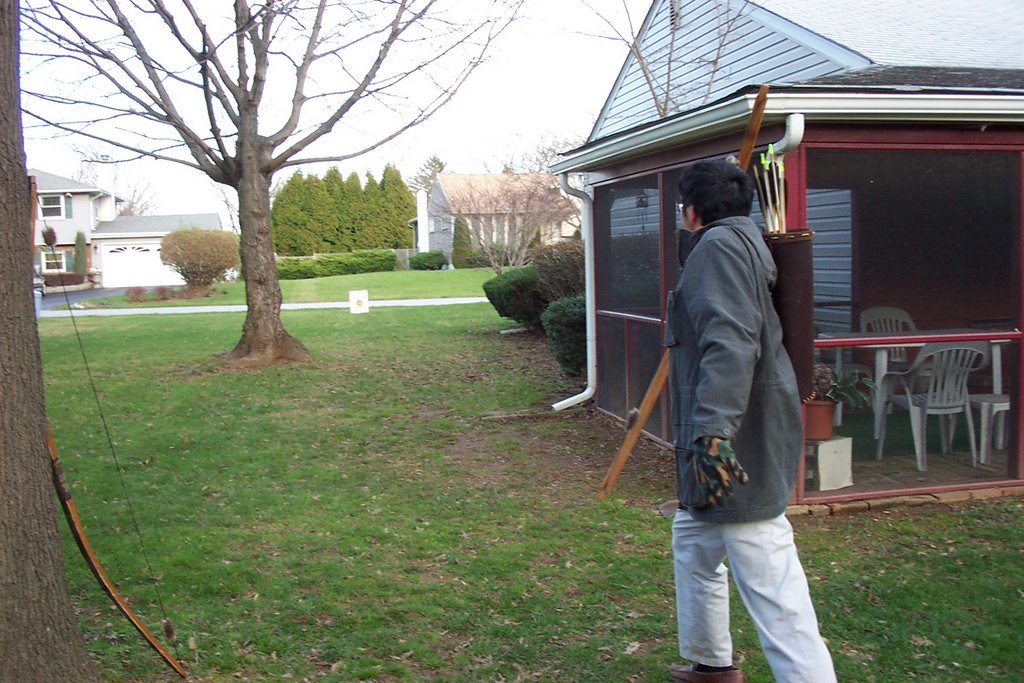
After a relatively uneventful winter, I've begun preparations for the taking of spring season small game. After checking my inventory, it struck me that several of the wooden arrows that I crafted last spring has warped over the winter and are now unusable, this leaves me with only 14 good hunting arrows left. Both of my crafted longbows were warmed besides the heater and then rubbed down with animal fat to restore wood elasticity. After such preparations, archery practice have resumed with renewed vigour on saturday.

The underlying trick to accurate primitive archery seems to be constant practice. After 2 months of neglect, I could barely hit the 30 yard target with 5 out of 10 arrows. Nevertheless the launching of handcrafted arrows from a handcrafted bow is a true joy to behold.