Saturday, May 31, 2008

Circumscribing the Island

Ever since I shelled out 50 dollars of hard currency for my used mountain bicycle, I had wanted to use the vehicle to circumscribe the isle of Manhattan. The bicycle is an incredibly energy efficient transportation device. For every mile traversed, the rider uses only about 25 calories of food energy. Riding the bicycle is literally a hundred times as fuel efficient as driving a car, mile for mile. In light of recent spikes in Gasoline prices, I believe that we need to entertain the possibility of a long term reduction in gas and diesel fuel supply. Thus cities should really make an attempt to drive it's citizens towards incorporating petroleum independent transport technologies such as bicycles.

In any case, I rode my little Trek Omega used bike 34 miles today, I circumscribed the entire island of Manhattan. Transporting yourself on muscle power alone is certainly tiring, but the efficiency of this machine was astounding. I was able to travel at roughly 15 mph. Going by bicycle in NYC is 5 times faster than walking, and nearly comparable in speed to auto transport. The Metro subway will be a bit faster, but no more than 2 or 3 times faster than the bike. My vehicle was essentially running on a bottle of water and my lunch(and giving the performance of a car!). Both of these resources(food and water) are renewable and can be locally produced. Instead of relying on imported oil from oppressive regimes half a world away, we can(and should) travel by the strength of our own legs. Besides, it was a hell of a fun ride! :D

Urban Garden Update

My little fire-escape Urban Garden has been doing rather well of late. The potatoes are growing profusely. I have tried some rudimentary catch cropping by growing chives around each of the potato plants. The same was done with the bean plants, which now seems to be flourishing. The Summer Squash seeds have not yet germinated, I'm going to wait for another week to see what happens there. The Tomato plant has survived multiple clippings by the birds and are growing again. I'm not sure how many tomatoes I'll be getting from this plant for the summer, but I'm holding out hope. The red onion is not doing so well, it has budded, but not growing that quickly.

Sunday, May 25, 2008

Urban Gardening Continued...

With the City of New York fully immersed in warm spring weather, I thought it proper to shift our attention to my "other" garden. The little urban container garden that I started last winter. I took the 2 herb pots and planted them with potatoes and chives. I also acquired several additional pots and a planter box from various sources. I filled in these containers with roughly 1/4 compost(from my worm compost bin) and 3/4 gardening soil. In totality, I have planted pole beans, potatoes, chives, red onions, and snap peas in in 6 containers on my fire-escape. I also moved my worm compost bin outside now that the night-time temperature is warm enough for the little creatures.

Saturday, May 10, 2008

Mother's Day Gardening!!!!

On Saturday, I got my mom flowers and took both of my parents to a fancy restaurant. I have a deep bond with my folks, and I often miss them terribly when in the city. Life can be quite hard sometimes, and the difficulties only makes me appreciate the love that my parents have shown me time and time again. And with so few chances to see them, one must seize every opportunity to do so. In any case, on Saturday afternoon, I got a chance to work in my garden. Much has transpired since the last time I was around here. The apple trees are in full bloom. The Red Delicious tree had beautiful white blossoms, while the Wine Sap tree was adorned with delicate pink flowers. These two trees are destined to be partners with each other in the coming years. The 2 blackberry brambles have met with a sad fate. One of the bushes had been pulled out by hooligans awhile back. The remaining bush, being planted closer to the rain water drainage pipe had suffered an unacceptable degree of root damage due to flooding. It's a regretable loss, but one learns more from failure than success in the garden.


The asparagus plants are growing fairly well, though with an acceptable degree of loss. Of the 7 crowns planted, 5 have survived and are growing woody green shoots skywards. After they get a little taller and put in some more leaves, I'll be filling in the trenches to encourage more root development. One of the crowns didn't survive the transplant, the dead crown was being devoured by worms. I removed the dead crown from that trench, and filled it with garden soil mixed with compost. In this cleared trench, I planted some corn and pole beans. Another crown appeared to still be alive, but isn't growing any shoots. This could be due to the trench being surrounded by vigorous sun-hogging clover or it could be due to the inferior genetics of the crown itself. In any case, I'll check on the crown the next time I'm home. If it still hasn't developed properly, it'll have to be culled.


The 4 container potatoes are doing extremely well. Container grown potatoes usually grow faster and yield a bit more than those grown in a garden bed for me. The Rotten and Yukon Gold varieties have expanded like crazy over the last two weeks, shooting a foot and a half higher than the last time I saw them. Thus, I had to fill more garden soil and compost around the grown plants, until the soil had reached the rim of each container. I'm seeing little sign of pest damage so far, which is pretty awesome!


Garden bed 1 is doing fairly well. The snow peas have largely developed, and are now climbing up the bamboo poles that I have set down there earlier. But it was pretty apparent to me that a significant portion of snow pea seeds have not germinated. This could be due to predation from birds or inferior seed stock. In anycase, I planted some pole beans(European and Kentucky varieties) to succeed the peas. The snow pea plants will end their life cycle sometime in august from the heat, and right then the next wave of pole bean plants would be just about ready to yield. Thus ensuring a continous stream of lingumes.

In garden bed 2, the situation was significantly better. Most of the sugar snap peas have germinated and are growing vigorously. So vigorously in fact, that I had trouble finding sites to plant my pole beans. For some reason the sugar snap peas grow and flower much faster than snow peas, yet the two varities can(and will) interbreed with each other at some point. After sowing some succession beans, I set down a roll of sweet corn along the edge of the bed. The sweet corn will develop in time to catch some of the pole beans, thus providing a living scaffold.


Garden bed 3 had a plethora of crops growing. There were 3 varieties of peppers(Afghan Red, Acapulco, Jalapeno ), 1 european eggplant(Plantagenet), 3 native-amerian squash varieties(acorn, butternut, summer). The peppers are growing furiously, taking advantage of the full sunlight. The lone eggplant is looking pretty sad with tiny bite marks on the leaves. I assume that it's due to aphids or some kind of mites. The eggplants have always performed poorly in my garden. I sometimes wonder if the Eurasian vegetable is hardy enough to survive here.
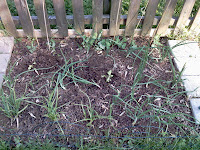
Garden bed 4 was the land of the onions. It's populated by Begian red onions and French yellow onions, their tubuler green stalks waving in the air. The 3 California garlic plants are doing just as well, with their flat stalks forming small bushes. There were several Wally Pea plants along my neighbor's fence. The wally peas are quite different from the snow and sugar snap peas, it's leaves are smaller and squat looking. The entire plant seems to be covered with very small and light hairs for some reason. Surveying the site, I found 3 spots for my Bok Choi seedlings. I had started 10 seedlings indoors a month back. The Bok Choi, being an East Asian lettuce variety, may not be adequately adapted to this climate. Of the 10 seeds started, 7 germinated indoors, and only 3 survived the seedling transition to the outdoor weather of early May. I'm not sure how many of the 3 will live through the shock of transplanting. I would be happy if just one of the Bok Choi seedlings made it to bolting stage. In anycase, I planted in some pole beans along my neighbor Peter's fence for good measure. The entire garden bed smells a bit like a kitchen to me. After the new plantings, I cut away some of the onion chives(1 lb) for my mom's kitchen. Both onions and garlic are cut and come again crops which will provide many more cuttings before the end of the season. The bulbs that are finally harvested are merely icing on the cake so to speak! Besides being tasty, onions and garlic are also packed with natural anti-biotics which keeps us humans safe from certain bacteria and parasites.


Garden bed 5 has 4 tomatoes(brandywine, beefsteak, early girl, cherry) and 1 cucumber plant growing in it. The plants in this bed are very heavy feeders of both nutrients and water. I planned this bed as a sort of experiment into the bio-intensive method of gardening. This approach will yield significantly more food than before, but will also require more effort in terms of maintenance. In anycase, the growing tomatoes are planted so closely together that they'll need to be trained to fill in a 3-dimensional cube of space directly above the bed. For this purpose, I shelled out some hard currency to purchase 2 sets of foldable trellises. These 2 trellises, were set down in a zig zag pattern, neatly supporting and partioning each of the 4 tomatoes. Basically, each tomato will be trained to occupy a separate cubic space created by the trellis, while the cucumber will be trained to fill a rectangular wedge of cubic space directly beneath the tomato canopy. This will create a single 3 dimensional block of densely intertwined plant vegetation, roughly 4x4x5 cubic feet in volume. Now so much vegetation will require a great deal of water. So I implemented a kind of green mulch, I cut the tall grass on the edge of my garden and layered them uniformly around each of the plants. The mulch serves the triple functions of supressing weeds, retaining water, and releasing nutrients into the soil, thus reducing some of the human effort required to maintain this structure.

Garden bed 6 has 6 potato plants. They are all doing well, though not as well as their container counterparts. I created small hills of soil around each developing plant and checked everyone of them for signs of disease and pests. Everything checked out fine so far. I then planted pole beans around the edge of the bed and along the fence. The potato/bean/turnip triad is a tried and true pattern for my garden.


Good times with my family and fun in the garden made it a great mother's day weekend. Though I must say, if that special person was there with me, it would've been perfection itself! :D

Solar flood light repair

In honor of Mother's day, I decided to visit my parents in PA this weekend. So on Friday evening, I took the train out of NYC to home. Now when I got to my parents' house, I heard the unexpected news that our solar flood-light had been out of operation for a week. That sturdy light had been working for the last 2 years, though with a gradual decline in performance. Over the last 4 months, only 2 of the 4 LED lights on the lamp had been working. A solar powered light is an incredibly efficient(and relatively expensive) piece of technology. Thus before we throw it out, it's worth at least one attempt at repair. So I put on the engineer hat and dis-assembled the flood light. The internal workings of the light are remarkably simple. The device is composed of basically 5 modules:

1 Photo-voltaic panel


1 Circuit board


1 Power pack holding 2 Nickel-Cadmium AA batteries


1 Plastic mount holding 4 LED lights


1 Light sensor

The PV panel collected solar energy and converted it into DC electricity. The energy is channeled through the circuit board to recharge the batteries during the day. The light sensor mounted at the exterior of the device would send a signal to the circuit board when the amount of light hitting it falls below a certain level(like during night time). The signal from the sensor basically tells the LED lights to begin drawing energy from the battery pack and converting that energy back into light. So what had gone wrong?Well, it appeared that the PV panel itself was protected by a thin slice of hard plastic. The ultraviolet rays from natural sunlight had basically broken down the top layer of that plastic, making the panel a bit opaque. This had the effect of significantly reducing the amount of solar energy the panel could capture. Additionally, some dust and mud had gotten onto the light sensor. This had the effect of making the solar light turn on earlier than necessary. Thus, the device was forced into collecting less energy during the day and using more of it at night. Now batteries tend to heat up when stressed for power, and at higher temperatures, the alkaloids within them become much more corrosive. After a period of time, the chemicals had eaten through the metal walls of one of the batteries, thus rendering that battery useless and knocking out 2 of the LED lights. Apparently, in the last week, the remaining battery had failed as well, making the light completely inoperative.

The solution was fairly simple. I replaced the dead batteries with a new set of rechargeable ones. That brought all 4 LEDs back online. Then I cleaned up the exterior of the floodlight, paying extra attention to the light sensor. After cleaning it, I tested the sensor under an indoor lamp to make sure that it was properly turning on/off the LEDs. The PV panel took some work. I used fine grade sand paper to clear off the top most layer of the hard plastic cover, until the PV cells were fairly transparent. I then took a very thin sheet of cell phone screen protector, and pasted it onto the hard plastic. Now instead of the plastic cover, the sheet will take the full brunt of the Solar UV damage. And when that sheet breaks down, we can just replace it with another one. After that, everything was working like a charm. I set the floodlight into it's proper place in our front yard, and it was shining gloriously again!

Sunday, May 04, 2008

Garden Update

My suburban garden is coming along at a fair pace. Both apple trees have bloomed and are now growing a green foliage of leaves. It will be 3 more years before any apples can be picked from these young trees. My parents have recently put in a back fence to prevent local youngsters from damaging the garden and our plantings.


The snow peas and the sugar-snap peas are both coming along very nicely. We need to put in some more trellis next week to accommodate the new seedlings. Peas are very useful as a cool season crop. If all goes well, they should provide us with a source of fresh legumes until late July.


The tomato seedlings are growing at a modest pace. We have put down three varieties this year: Beefsteak, Brandywine, and Early Girl. I think the growing plants will need additional stakes for supports within a few weeks. But everything looks good for now.


The red onions and garlic have both come up out of the earth. Their chives are almost ready to harvest. I think within the next 2 weeks, we should be able to begin cutting some of the green chives. Once each onion plant has reached a certain height, a portion of the plant can be cut back once a week until harvest time.


The container potatoes have done better this year then the ones planted within the bed. For some reason the 6 potatoes set down within the garden bed is growing slower than normal. It is possible that not enough compost have been fed to the soil, but I suspect the real reason could be either a soil pH imbalance or inferior quality potato buds.

Sunday, April 20, 2008

No Tillage Agriculture!

While doing some research online on do nothing farming, I had the good fortune of meeting Steve Groff at Cedar Meadow Farms. Basically Steve is practicing a form of agriculture that seeks to mitigate plowing the land. In effect, it conserves top soil while simultaneously saving gas and human effort. After a few emails, I decided to visit his farm and see how large scale no-till agriculture worked first hand. So last weekend, I took the train home to PA and got into my Honda Civic for a field trip of sorts. I drove some 40 miles Westwards into the agricultural areas of Lancaster County. There were many Amish families inhabiting those parts. Their 19th century horse and carriage lifestyle presented a rather odd contrast with the rapid expansion of suburbia into Lancaster.

After finding the farm, I had the pleasure of chatting with the man. Apparently, Steve's method of farming uses only around 30% of the fuel, and 70% of the fertilizer as conventional agriculture, while still allowing for a single family to cultivate over vast acreages(250). Of great interest to me was the savings in time. According to Steve, he was able to cut down his work hours by 75% due to not tilling the soil while farming. Of course by that time, I was bouncing off the walls to see the actual process in action. So out we went to tour the farm.
Steve is using a form of seeding and cover-cropping that is very similar to those practices described within One Straw Revolution. However, his own interpretation is highly mechanized and thus much more scalable. For example, in OSR, seeds were encapsulated within "earth balls" and scatered into the fields by hand. While Steve's tractor simply carves a very narrow slit about an inch deep into the earth, disperses the seed,and then these two bevel seals the ground up afterwards, thus accomplishing the same purpose with machinery. Steve actually demonstrated his tractor for me, and it was amazing to watch. The process of tilling the soil is highly tedious on both man and machine, I have had the good fortune to experience both. But the act of simply scratching the soil and depositing the seeds seemed much easier and faster to me.

The farm itself uses the principals of natural fertility and continous cover described in One Straw Revolution. Steve has been using a combination of corn and wheat as harvest crops along with vetch/rye and turnips to provide the cover crops and green manure. While touring the farm, I have noticed examples of such continuous coverage. In one field, I could see the remains of corn stalks after the ears had been harvested, and underneath these brown stocks there grew a green carpet of vetch and rye. Along with the crops, Steve also keeps a small herd of buffalos on his farm. It seems to me that this way of agriculture is much more efficient and sustainable to the mainstream method currently in place. Steve mentioned that the difficulties of No-till agriculture was in the transition process. During the first years of transitioning, more fertilizer must be used and harvests could be smaller, thus farmers risk possible ruin in making the switch. After seeing the results of this method, I personally think the government should subsidize this transition process and convert as much of our farmland to no-till as possible.


Saturday, April 12, 2008

Green Drinks Social

We attended the monthly NYC Green Drinks event on tuesday. It's a great gathering of NYC entrepreneurs within the emergent Green Industry. This gathering offers us a global sense of what is happening in the sector along with the chance to pitch our own permaculture business. This month's session had quite a collection of demonstration technologies. The current environment of inflated food and energy prices seems to have brought forth a wave of innovative inventions.

We saw a foward mounted bike trailer that is supposed to be 25% more efficient than it's conventional, rear-mounted counterpart.


There was one exhibit of tadpoles which were selectively bred to feed on sewage waste, and thus serve as living waste water scrubbers.


Yet another nifty innovation we saw was a google mash-up. It basically layered semi-realtime fuel consumption data-feeds onto locational markers within Google Maps. Thus, city planners would be able to graphically gauge efficiency spending priorities within different sectors of a metropolis based on need.


Friday, April 04, 2008

Huge Showing at the Gardening Class


As part of our little business, http://grown-up-permaculture.com/, we have been giving a series of free Gardening/Permaculture classes to the NYC community. Our last class on thursday generated a huge showing, close to 40 people attended! We taught the basics of gardening design, permacultural tips, and of course some detailed instructions on container and watering systems design. My hope is to teach as many people as possible the knowledge of producing their own food in small urban spaces. With massive increases in food and gas prices, the economic conditions of this city may get a bit worse before it gets better. Everyone who are feeling the pinch at the grocery store should be thinking of starting their own garden. By regaining a small measure of food self-sufficiency, we can go a long way towards saving some money and bettering our health!

Thursday, April 03, 2008

Spring Planting Underway!!!

On Sunday, we began planting the annuals in earnest. I had acquired a stock of seed potatoes of the Rotten, Golden Wonder, and Kennewick varieties. These spuds, I quickly planted about 3 inches deep within garden bed 6(the newest) and both containers. Potatoes, being asexual clones, are highly susceptible to diseases. Thus they should either be planted within clean soil or have at least a 3 year rotation before being replanted within the same ground. Using this model, the first 4 garden beds, being planted with potatoes within the last 2 years, are unsuitable for further potato production this year. Another matter of importance is that of having multiple breeds of the same crop. Many breeds of the same species ensures genetic diversity. And genetic diversity is possibly nature's greatest defense against diseases and pests, because quite simply, no disease can completely wipe out a highly multifarious plant population.

The onion family was next, these I mostly planted in bed number 4. First, I planted a sub-breed of the common California garlic, known for it's large white cloves. Next, I choose French Yellow onions and Belgian Red Onions. These two varieties are known for their disease resistance, and of course their multiple functions. The leaves and stems of the plant are edible as cut and come again scallions, while the root bulbs are the actual onions harvested in the fall. Finally, I planted additional Asiatic green onion chives along the edges of garden beds 1 and 2. I already have more than enough green onions growing in the wild, but this planting isn't just for food. The point is to inject more new genes into the wild onions' gene pool, thus strengthening the plant's hold on my backyard environment.

Garden beds 1 and 2 were planted with 2 continues crops of heavy feeders(potatoes and corn). Thus, the soil would be quite depleted of vital resources such as nitrogen and phosphate. Because of this, I decided to plant both beds with peas to rebuild the richness of the soil. Legumes fixes nitrogen through their roots, making the soil more fertile over time. Yet another reason is a potential defense against the dreaded Japanese Beatles. We know that the bugs reach a reproductive apex in July before quickly expiring in early August. While at the same time, the peas would be naturally dying out in July(due to heat) as a second set of pole beans grow over the pea plants. Thus, it may be possible for the bugs to feed upon the heat damaged peas after the plant has lived past it's lifecycle. This would create a permanent niche for both the beetle and the peas, while saving the rest of my garden from devastation.
I chose 3 varieties: snow peas, sugar-snap peas, and wally peas. Each of the sub-breeds is slightly different, the sugar snap has a higher concentration of sugar, the snow peas tolerate lower temperatures better, while the wally peas have a hard protective shell. These minute genetic differences should suffice for some of these peas to survive a hard onslaught of pests. I planted these seeds and set down bamboo stakes as a support trellis.

Sunday, March 30, 2008

Suburban Garden Expansion Part Three!

I came home to Pennsylvania this weekend to resume work on the garden. Spring is such a wonderful time to be alive! Many trees were budding (including both of my apple trees), and some were even flowering. On Saturday morning, birds are chirping everywhere, a falcon circled the turquoise sky. Our neighbor's dog, Biscuits, was lounging around, and my backyard was awash with the verdant colors of new growth.


Before even starting my work, I noticed strange tufts of green grass growing all around the back of our property and extending a bit into our neighbor’s yard. There were dozens of such plants. Upon closer examination, I realized that these little plants were the descendants of the 4 heirloom green onions that I grew last year. The green onions are cut and come again annual vegetables whose seeds are propagated by the wind. Apparently, the 4 original onion plants had cross-pollinated each other. Their children must have colonized the marginal lands adjacent to the two properties.

And the land is surely marginal, stuck between my garden and my neighbor's flower beds, it's rocky as hell and laced with pine needles. The only plants growing there are some weeds, lichen, and of course my onions!!! This fortunate colonization will provide our family with several times the amount of edible green onions as compared to last year, and without any additional effort on our part. What we are seeing is in effect, permaculture in action. Our plant has created a niche for itself in a previously barren habitat.


After examining the green onions, I went straight to work. Seven new V-shaped troughs were created with the trusty shovel and pick-ax. Three of them were along my neighbor’s fence to the east, another four were dug along the land bordering our neighbor to the south. These troughs were about a foot long, six inches wide, and ten inches deep. The bottom of each trough was lined with rich compost and buffered with three inches of organic garden soil. The four troughs along the southern edge of the backyard had to be fortified with extra garden soil, since the natural soil base there is so poor and rocky to begin with. Each trough is then given a single asparagus crown buried under another 3 inches of garden soil and then watered thoroughly. In time(hopefully) the asparagus will become a hedge like border that produces food and acts as a windbreak.

The asparagus is a perennial plant that once established, will produce nutritious green spears for decades. While the reproductive strategies of plants are varied and interesting in general, the strategy taken by the asparagus is highly unconventional in my opinion. Basically, a parent Asparagus’ root system is composed of crowns of individual root shoots. Now depending on environmental conditions or just plain chance, some of these crowns will bud off or get broken off from the main root structure. Each crown has the potential of becoming an independent Asparagus plant. Yet unlike other budding root plants, each crown isn’t a clone of the parent, it’s actually a bundle of genetically distinct child asparagus cells surrounded by the parent’s root tissue. As a newly broken crown grows, the child cells will replace the parent tissue, cell by cell. Thus, prior to budding, it is as if a parent plant and all of it’s children are part of the same functioning organism!

Sunday, March 16, 2008

Suburban Garden Expansion Part Two!

On Sunday, I decided to add some much needed perennials into the garden. The trouble with annual crops such as corn and tomatoes is just that...these plants only live for a year. The act of breaking ground and sowing new seeds every year is a relatively uncommon and highly destabilizing event in nature. Firstly, fine tillage of even small plots require substantial amounts of energy. Industrial agriculture makes this look easy through the extensive use of non-renewable fossil fuels. And as we have seen firsthand yesterday, doing the job with muscle power alone is incredibly exhausting. More importantly though, the act of plowing destroy soil systems. Huge amounts of nutrients are leached out of plowed soil through erosion, thus requiring the tedious application of fertilizer and compost every year. Beneficial insects and micro-organisms are killed wholesale through the breaking of ground, paving the way for later epidemics of pests and weeds. Interestingly enough, weeds are nothing more than hardier, low-yielding relatives of the common grains that we consume. Without broken earth, weeds would have no place to establish themselves. Thus when we plow our fields, we are literally sowing the seeds of our own future misfortune!

These is where perennials come in. These long-lived crops require but a single planting and can yield food for decades or even centuries. But of course, nothing comes for free in life. Planting perennial crops takes a ton of effort. We started early Sunday morning by planting two apple trees of different breeds, golden delicious and red winesap. Apple trees require a significant degree of genetic variety to ensure successful cross-pollination. My father and I started by digging two giant holes in the ground spaced 15 feet apart. These holes were 3 feet across and 1.5 feet in depth. We attacked the ground with the trusty shovel and pick-ax. The work was brutally hard. Below 6 inches the ground turns into hard clay, below a foot, the clay earth is packed with boulders the size of bowling balls. We literally removed hundreds of fist sized stones and a score of boulders with the pick ax and our bare hands during the excavation. The soil that was dug up had to then be siphoned for larger stones, this was back-breaking work which yielded hundreds of additional egg-sized stones.

After the deed was done, we began to manually rototill large amounts of sand and rich garden soil into the 2 hills of unearthed clay soil. I wanted to use compost initially but after some research, it appears that compost would burn the roots of the young trees. In any case, some of the soil mixture was carefully spread into the base of the hole until the top of the young tree's root bundle stood at exactly ground level. At that point we transplanted the young trees and began shoveling in the rest of the soil mixture around the tree. We packed the soil down hard with our feet to ensure that the tree was firmly anchored. The next step was to hammer down some of our unearthed stones around the edge of the now filled pits, thus forming a lithic mulch. The stones basically absorbs solar energy during the day, and releases that energy as heat at night, thus warming the delicate young roots of the trees. Additionally, rainwater leaches essential minerals out of the circle of stones into the soil whenever it rains, thus serving as a long lasting fertilizer for the tree.

The last stages of the tree planting were pretty straightforward and not too exhausting. We dumped gallons of fresh water into the soil and then topped the entire soil bed off with 2 inches of mulch. The mulch helps the soil retain moisture.


After a short break, we started on the blackberry plantings. The process itself is pretty straightforward, dig a small, 9-inch deep hole, add some compost, and drop in the sapling. But the difficulty was in determining a location. The berry performs best under conditions of moist, acidic soil, and good sunlight. But we had no such place to put this plant, at least no place that wouldn't be threatened by the lawnmower. After arguing for a bit, the decision was made for us. My mother began berating us from the second floor of the house about messing up her backyard. The complaints were largely ignored, however, she did point out a hitherto unnoticed fact. Our yard's old satellite dish was unused, since the TV satellite had long ago fallen out of orbit. Yet the dish was sitting on moist ground right next to the rainwater drainage pipe connected to our roof. Moreover, the land was in full sun and close to our pine tree, so the ground was laced with pine needles, making it acidic. Thus, we removed the huge old satellite dish and planted in our blackberries.

After the day's exertions, my body ached all over. I couldn't even hold onto my laptop very tightly as I left the land of my childhood back towards the island of glass and steel that is Manhattan.

Saturday, March 15, 2008

Suburban Garden Expansion Part One!

The delightful weather of spring has lured me back home to Pennsylvania this weekend. I had some major improvements in mind for the suburban garden. So bright and early Saturday morning my father and I got to work. I chipped away at the hard clay soil of the lawn with the trusty shovel. The goal of the effort was to create 2 additional semi-raised beds for the garden. Reclaiming agricultural land from the standard suburban lawn has always been a tedious task, and before long my arms and back were straining due to the sheer human effort. The lawn soil was of course devastated by the repetitive use of the same type of grass along with harsh chemical fertilizers/pesticides. It was hard and yellow, almost like clay. To add to the difficulties, we live in a region of rocky soils. So the clay soil was filled with egg sized stones which had to be removed by hand! After a while, the old rhythms of garden bed creation took over. I shoveled out pieces of lawn grass in a row and removed the underlying earth to form a foot deep trough. After which I stamped down the pieces of turf upside down along the spine of the trough. Finally, the entire row was filled with the removed dirt. The upside down turf serves as an initial nutrient layer to improve the hard yellow soil. For each row of cleared turf, I also added in several pounds of composted leaf molds to further increase the soil's organic content. Some 3 hours of hard manual labor transpired, but eventually I was finished, and exhausted by the effort.

Meanwhile, my father was busy spreading out the compost upon the 4 existing garden beds. Each bed recieved roughly 20 lbs of rich black compost. Since we have deposited at least 40 lbs of fish guts into our piles over the last year, the resultant compost was especially rich. It had a thick, semi-sticky consistency, quite like some sort of petroleum product in fact. Fertilizing the fields required him to manually roto-till the compost into each of the existing beds. Every last bit of the compost was worked into the soil, nothing is wasted around our little garden. Along with the compost, some leaf molds and a small amount of pine needles were also worked into the earth. The leaf mold serves as a good source of carbon to aerate the soil, while the pine needle gave the soil PH a slight kick towards the acidic spectrum. I figure we needed to put some more natural acidic fertlizer into our beds due to harvesting over 200 lbs of tomatos out those same beds.

As we worked, I could not help but feel that we are but following in the foot steps of a hundred generations of farmers before us. A food-producing tradition that has spanned a journey across continents and millennia. What is surprising to me is not that we are personally farming the land as our ancestors have done before us. Rather the surprise comes from the fact that most of my(and my father's) generation would be the first people in all of human history to NOT produce our own food. We are the first broken link within this continuous chain of tradition that stretches back thousands of years. Thus it may be the case that producing one's own sustenance locally is a norm in human history, while our current long-distance consumerist way of life is merely a brief exception. A single broken link in an otherwise flawless chain.

Saturday, March 08, 2008

Inspired by a Symposium!!!

My winter-time drudgery of work, sleep, rinse, and repeat has been delightfully lifted by the soft showers of spring. Much has transpired in the last 3 months. Our green business, Grown-Up-Permaculture, is off to a great start. Work is already underway on multiple rooftop garden projects with several major clients. Needless to say, I have been in work fanatic mode for quite a while now. It's not easy keeping the day job and a hobby-turned business at the same time!


So to scout out the landscape of the green movement here in NYC, I decided to take a field trip today to the 27th Making Brooklyn Bloom Symposium held at the famous Brooklyn Botanical Gardens. So in the soft rains of march, I made my way to Prospect Park and entered the main Botanical building. The conference hall was packed with Green businesses, non-profits, and community groups of all sorts. There were companies and organizations representing almost every aspect of the Green movement as it relates to food production. There were CSA(community supported agriculture) provider groups, urban farmers, educators, forest gardeners, human-powered produce delivery firms, poultry raisers, seed distributors, resource recycling outfits, and a host of other green niche groups. So many people attended today that the conference hall and every single workshop for the entire day was packed and overflowing with New York urbanites.

I found much useful information( and amusement ) while attending a series of highly detailed workshops ranging from urban soil lead mitigation to raising chickens in the city to the fine arts of indoor seed sprouting and dwarf tree pruning! I felt energized by the sheer level of dedication, enthusiasm, and hope that so many people at the conference seemed to genuinely have. Prior to today, my notions of the purpose of a garden spans the vague concepts of natural self-sufficiency to that of an interesting stress-relieving hobby.

But this gathering has
expanded upon those initial ideas. Using organic agriculture and perma-culture, we can actually change this city, and the world, for the better. The conference's themes of teaching the needy to gain nourishing sustenance for themselves, providing honest work for those without opportunities, and achieving a degree of equality(even if only dietary :P ) for everyone, these messages simply strikes a solid cord within me.

I know that the foundations of our world cannot and will not change. Politicians will always be corrupt, big corporations will always try to suck people dry, and the elites will continue to do anything to maintain the status quo. No matter what we do, we'll still face the challenges of resource depletion, weather changes, and economic dislocations caused by our own foolishness. But despite these looming issues...we still have within our hands the means of making our world so much better. This gift of knowledge, just the knowledge of growing food for one's self and family, it shouldn't be denied to anyone. And if people with the means simply had the heart and will to spread this knowledge to their friends and neighbors, just think of how awesome our world would be. I saw a glimmer of such heart in a bunch of ordinary people today, and it really inspired me. Perhaps I'm still too young, but I can't help admiring these people who try so hard to make a better world despite the odds stacked against them. And come to think of it, it would be my greatest fortune if our own little quest can end up making a positive difference in the lives of others.